


Research
Winning in the Marketplace Starts With Winning in the Workplace
Winning in the workplace is not about amassing a dream team comprised of star talent. It’s about taking the talent you have and enabling them to win.
July 19, 2018
- West Monroe surveyed 109 experience professionals on their employee engagement and experience viewpoints (see more in Methodology). Our survey results are a powerful testament to the value of empowering talent.
Introduction
Companies today face enormous pressure to adapt to shifting expectations, technology, and markets. For many organizations, the pressure is nothing short of existential. Consider that only 12% of companies that were part of the Fortune 500 in 1955 still existed in 2016.
Amazon’s recent entries into the grocery, financial, and healthcare markets remind us that disruption is pervasive. Though technology is subverting business strategies and changing how employees work, digital tools alone do not create a durable advantage.
To compete in the fast-changing marketplace, smart companies are focusing on digital transformation and delivering an exceptional customer experience. What’s often missing, however, is the understanding that engaged employees are key to achieving success.
An empowered workforce underpins any effort to improve customer experience—both of which boost profitability, productivity, and agility. Yet many companies are failing to optimize their most important asset: their people. More succinctly said, winning in the marketplace must first start with winning in the workplace. That’s the conclusion of our survey of more than 100 members of the Customer Experience Professionals Association (CXPA).
Winning in the workplace is not about amassing a dream team comprised of star talent. It’s about transforming competent employees into superstars by cultivating an engaging culture, intentionally designing employee journeys, and empowering them with digital tools to thrive. It’s about taking the talent you have and enabling them to win.
Survey Highlights
In the coming pages, we uncover three elements that are necessary to properly harness your talent. You must engage employees, design employee experiences, and enable employees with digital tools. By focusing on the people, the processes supporting them, and the technology they are using—and not just one of these things—you create a very strong and powerful combination that drives productivity and growth.
- Respondents say a motivated and equipped workforce is most critical for their company to achieve the following strategic priorities: customer experience (53%), business agility (50%), and digital transformation (49%).
- In ranking their companies’ top 10 priorities, most respondents put these three initiatives toward the bottom of the list: employee engagement, employee experience, and employee enablement (through technology). Ten percent did not even rank employee experience among their top 10 priorities.
- Two trends are causing the most pressure for change in how employees work: increased competition to recruit and retain talent and high expectations of existing employees. These both speak directly to the need for creating and sustaining a top-notch employee experience.
- Companies demonstrated a low level of commitment to employee engagement, particularly in soliciting employee feedback. Fewer than half of respondents’ companies survey employees about their overall experience or about their opinions of the company and its operations more than once a year. Roughly 7% sought such feedback in real time, despite an accelerating pace of change, mounting expectations from the workforce, and a growing list of platforms enabling them to obtain real-time input.
Chapter 1: Engage employees: Win people’s hearts and minds
Employment no longer entails simply exchanging a paycheck for tasks, effort, and hours. Employees demand more from their employers—the latest technology tools, work-life integration, emotional satisfaction, diversity, inclusion, fair pay, etc.—while employers are demanding more from their employees, such as 24/7 availability, heightened productivity, and loyalty. Younger employees seek roles with purpose and meaning and look beyond job duties to decide where to work.
The returns on an engaged workforce are substantial. Engagement reduces absenteeism and turnover, improves customer relationships, boosts growth, and delivers greater profitability.

Simply put, engaged employees produce better business outcomes than other employees do— across industries, company sizes and nationalities, and in good economic times and bad
Gallup
High levels of engagement can help companies recruit specialized talent amid a tight job market and help them retain talent at a time when mobility is easier than ever. But even in the face of clear, compelling reasons for making employee engagement a top priority, our research found that employees often feel they are anything but engaged. Nearly a third of respondents said employees at their company were not happy with their engagement:
- 42% rated their organization at 6 or below on a scale of 0 to 10. Only 13% were positive, rating 9 or 10.
- Fewer than a third of respondents said their company leaders took action to demonstrate the value delivered by employees and their contributions to customers.
- A quarter of companies lacked any tool to benchmark employees’ impressions of the company.
Defining employee engagement
3 Levels of Employee Engagement: Hiring, Socialization, Recognition
Hiring
Getting the right people into the organization who believe in the purpose makes the job easier. Embedding the company’s north star into recruitment materials and hiring processes increases cognitive buy-in to the broader goals and helps organizations hire for the desired behaviors and traits.
When American Express sought to metaphorically “hug” every customer who called the contact center, it changed the type of person they typically recruit. The company began looking for child-care providers, hospice workers, and others who had a natural sense of empathy rather than simply having previous contact center experience.
Socialization
Communicating and training employees (formally and informally) ensures that they understand the vision and their roles in carrying it out. Communication and training plans should outline essential messages and skills for key employee groups, including leadership. As one participant in West Monroe’s survey noted, “During any transition period, you cannot communicate enough.”
While some respondents were critical of executive communication efforts—one said “senior leadership are isolated and non-consultative”—we found that communication is not among the top challenge areas for companies. Nearly 50% of respondents rated this area a 7 or above.
Companies that communicate well use a variety of tools that include artifacts (e.g., posters, videos, meetings-in-a-box). Similarly, firms with robust training plans look to not only adapt existing formal training (onboarding, sales, leadership) but also do things like building champions or change-agent programs that give employees the skills to navigate through disruption. Humana’s FastStart program circulates people from across the firm to learn about lean start-up and design thinking methods that enable them to experiment and innovate rapidly as they serve customers.
Rewards and Recognition
Informal, alternative rewards and recognition can motivate employees as powerfully as compensation.8 Rewards could include flex time, work-from-home permissions, casual-attire days, or a variety of other options that would appeal to the target workforce. Reward behavior and actions that exemplify the intent of the north star—not just scores to avoid gaming. One company that participated in West Monroe’s survey: “Every month, our CEO holds an all-staff meeting. Employees who stood out (from our customers’ standpoint) are named and their successes are celebrated. This customer feedback can come from any source."
Cultivating employee engagement: 3 steps
Considering the substantial benefits of improving employee engagement, it is surprising that so many companies are failing to meet expectations. The following are some key techniques to help guide company engagement initiatives.
1| Infuse a North Star with purpose
Superstars don’t exist because they want to; they answer a calling. The same holds true for employees. To get employees to follow you, you must provide them a higher purpose to follow—not just a paycheck.
Good north stars embody the purpose for serving target customers in a specific way. For example, USAA focuses on serving military families with the same degree of dedication with which those families have served their country. Tesla strives to accelerate the world’s transition to sustainable energy.
2| Engage leaders to role model behaviors
Actions speak louder than words. That’s why leaders modeling the right behaviors and decision-making is so important. When Southwest Airlines’ CEO Gary C. Kelly flies as an average passenger, it speaks volumes. After a recent flight, a Southwest customer told CNBC: “[Kelly] didn’t priority board. He didn’t take a seat upgrade. He waited like everyone else, and he sat in the back.” Several people described Kelly chatting with fellow passengers. “On Southwest, there is no second class, and every seat is great,” Kelly said after the flight.
To exemplify behaviors that achieve the North Star, leaders must understand how customers experience the company’s products and services—and how employees deliver them. To do this, executives can spend time listening to calls, visiting customers, and engaging in “Undercover Boss”-like immersion efforts. Apple’s CEO, Tim Cook, reads customer comments every day. Why? “Because it’s like checking our blood pressure,” he said. Companies like Wendy’s, Humana, and Northern Trust have established “customer rooms” that immerse leaders and employees in the customer experience.
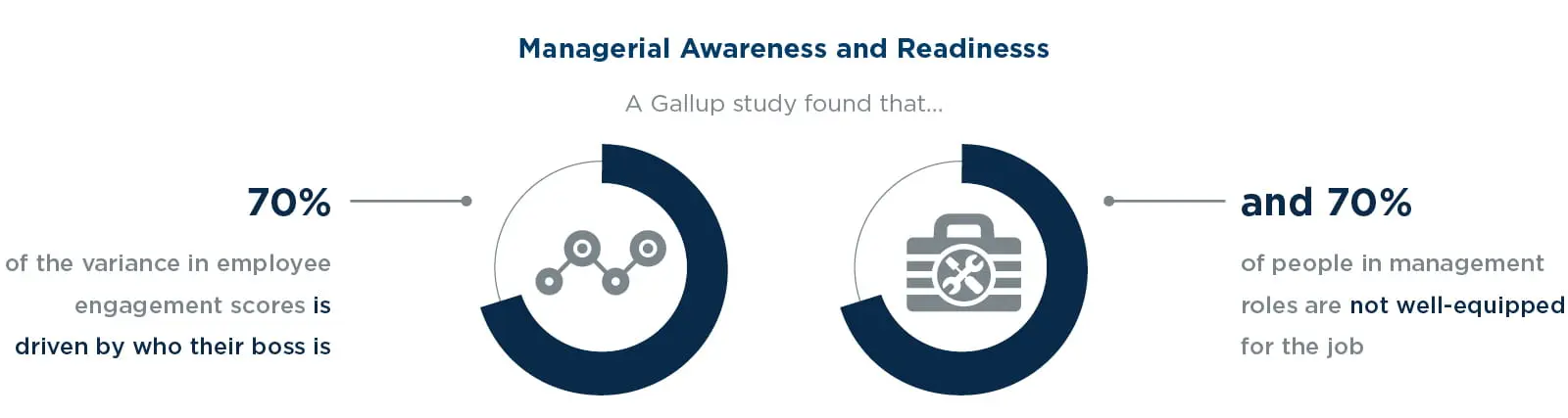
When it comes to modeling the right behavior, top leadership is important, but middle management is also critical. In particular, middle management must be able to translate the company vision/strategy into action for front-line employees. And, West Monroe has found that employees tend to assimilate or react to the behavior of their boss, not of the CEO. Forty-two percent of new managers report developing their management style through observing a previous manager, rather than through formalized training. As such, managers are critical enablers of employee engagement, driving the C-level strategy down to day-to-day operations.
3| Listen to employees more frequently
Listening to employees only once per year or less—which our survey says is common—isn’t enough. Instead, companies should keep a real-time pulse on employee sentiment. Modern tools from Qualtrics, Medallia, Confirmit, and Tiny Pulse can encourage real-time feedback on announcements, projects, or executive speeches, enabling a company to course-correct immediately or address employee concerns that would otherwise undermine its ability to move forward.
Google has a real-time internal tool that provides executives with immediate feedback, even during all-company meetings, offering insight into how employees feel about direction and messages. Social media tools like Glassdoor and Fishbowl can also be a source of uncensored intelligence.
Chapter 2: Design employee experiences: Build processes to thrive
Defining employee experience
Strategies for designing an optimal employee experience
Just as employee engagement activities get the workforce energized about a new direction, experience design detects roadblocks within processes or policies and empowers employees to succeed. Many organizations already have capabilities resident in their customer experience organizations that internal project and HR teams can use to design experiences across the employee journey.
1| Map employee journeys and life events
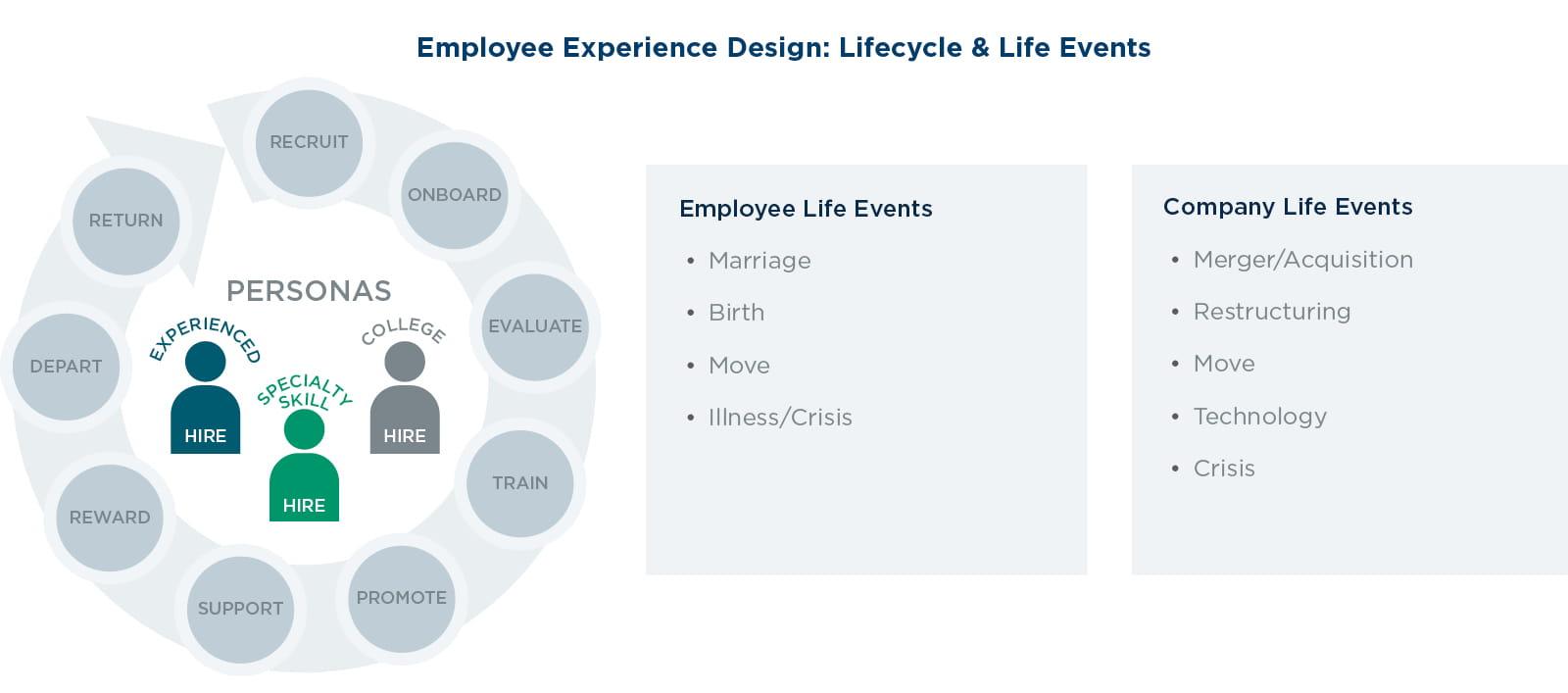
Like customer journey maps, employee journey maps shed light on how an employee experiences a set of processes and tools to perform a job. These journey maps illuminate disconnects in underlying processes, hand-offs, and systems as the employee crosses different internal departments and silos. At the project level (e.g., implementing an employee portal or customer relationship management solution), even simple employee journey maps can quickly uncover key requirements that will simplify jobs. Journeys provide insights to design better experiences, reduce anxiety, and speed up productivity by eliminating disconnects across departments or processes.
When mapping employee journeys, look at both the typical employee lifecycle (e.g., recruitment, onboarding, promotion) as well as specific employee “life events” (e.g., birth of a child, marriage, crisis) and company “life events” (e.g., merger, move, re-structuring, layoff). All have significant impact on employee experiences which companies can intentionally design and monitor
To increase the effectiveness of its district managers, a large food retailer conducted a “day-in-the-life” study to understand not only how employees spent their time but also their frustrations and needs. This exercise shed light on opportunities to increase operational effectiveness while also serving customers better.
2| Co-create and prototype the future with employees
Co-creation engages employees early in a design process. Prototyping engages them again later, as the design comes to life, allowing them to envision and react better to what the end state might look like. Used together, both processes can create better results than traditional “book- ending” that uses employee interviews at the beginning of a design process and activities such as user acceptance testing at the end.
When designing a new portal that would provide the foundation for a digital workplace, the American Medical Association sought input from employees across the organization through a survey and interviews. The interview participants then became a “panel” that continued to provide input in various ways throughout development. AMA’s project received an award as one of the world’s Top 10 intranet sites from preeminent user experience gurus Nielsen Norman Group.
3| Eliminate rules and policies that hamstring employees
That’s why companies like HootSuite, Vail Resorts, and TD Bank have hosted “worst policy” contests to identify and get rid of them. Contests like these empowered employees to use their best judgment and adapt policies as needed to do what’s right for customers.
4| Embed “defining moments”
Behavioral science shows that not all moments of an experience are equal. Dan and Chip Heath, co-authors of The Power of Moments: Why Certain Experiences Have Extraordinary Impact, describe how behavioral psychologists believe some moments of an experience impact people differently than others. The authors point to four defining moments that firms can intentionally build into: elevation, insight, pride, and connection.
When developing employee experiences, companies should pay particular attention to designing “defining moments”. Life events, career progression, and location moves are all ripe moments for redesign. For instance, some companies create an amazing welcoming experience for an employee’s first day on the job.
5| Support new ways of working through organizational design
Given the social, strategic, and technology pressures changing how employees work, companies should look to embed modern organizational design and management principles. These include cross-functional teams focused on delivering outcomes rather than projects and roles that empower employees with some level of freedom
to make decisions related to their work. Firms like USAA, Barclaycard, ING, and Lloyds Bank use customer journeys as a lens to provide context and direction for cross-functional teams or squads to overcome organizational silos, as well as hone the allocation of resources and strategic investments.
Chapter 3: Enable employees with digital tools
A digital workplace provides employees with the tools that allow them to work effectively with colleagues— and from wherever they need to. Digital transformation is changing all facets of the way organizations operate, from the inside out.
Digital transformation is changing all facets of the way organizations operate, from the front to back end. In two years, 65% of business leaders expect to see substantial impact from their digital technologies according to a Harvard Business Review Analytical Service survey. In November 2016, only 21% made that statement.
Defining employee enablement
Cultivating Digital Enablement
Despite the compelling benefits, many organizations struggle to get their digital workplace journey off the ground. The following tactics can help your organization build toward a digital workplace that enables employees.
1| Start with the humans—not with the technology
Design for humans instead of forcing them to adapt; technology should complement people’s strengths. A persistent pitfall in tech engineering is the tendency to automate wherever possible, while leaving humans to fill the gaps. “This forces people to behave according to the machine’s needs and on its terms,” as design researcher Don Norman wrote. It results in processes that are dull, demand an excess of attentiveness, and otherwise aren’t suited to human attributes like creativity and curiosity.
When the American Medical Association began its digital workforce transformation, it started with a research effort of employees at all levels of the organization to highlight their needs, habits, behaviors, and motivations. This guided digital investment decisions, design, and deployment.
2| Emphasize change and transformation investment over technology
Spending a couple million dollars on new technology? Double or triple that spend for managing the mindset and behavioral change that must accompany the technology.
Some of the most successful activities to understand and influence new behaviors include the following:
- Create a “behavior roadmap” that outlines new behaviors and how these align to and/or differ from current behaviors—along with a timeline for desired completion.
- Communicate how new processes and tools support desired outcomes and how they support the company’s North Star or vision in how they serve customers, not just about the new tools and processes themselves.
- Utilize goal-based learning that provides users with a situation and desired outcome and then teach them how to use the new system, reports, and data.
- Ensure leaders and first-line managers understand desired outcomes and behaviors and how they can coach and mentor their employees through these changes.
- Reward desired activity by incorporating desired behaviors into job descriptions during the hiring process and annual review process.
3| Automate the mundane
Among most effective applications of digital enablement is to target mundane tasks that humans do not complete well. These include repetitive, manual, and time-consuming tasks that sap morale or induce boredom. Automation frees employees to do more meaningful, inspiring, and impactful work, transforming them into superheroes empowered to succeed. West Monroe recently found that 59% of managers are spending more than three hours a day on administrative tasks—valuable time they could be using to lead and manage teams and drive engagement.
Capabilities like robotic process automation (RPA) can automate processes or certain job responsibilities, freeing up employees to redeploy their time elsewhere. Imagine the most repetitive part of a job—perhaps tasks that require copying data from one source and pasting it elsewhere or performing the same action hundreds of times a week for each customer or client. With RPA, bots can handle these manual and repetitive tasks.
Job responsibilities handled by bots free up hours that employees can use to focus on critical value-add activities that require discretion and cognition. For many employees, this will require uptraining to ensure employees are prepared to take on those value-add tasks.
Many organizations are finding robots can add value to employees’ roles. For example: “backup” coverage— working 24/7 (without getting sick), handling some tasks faster than employees working manually, avoiding transposition or other data-entry errors altogether, and freeing employees to handle high-value tasks.
4| Supercharge employees with data
Employees should be enabled with data that makes them smart. By freeing up the right information for employees at the right time, companies can increase the velocity and relevance of insights, leading to better decisions.
Typically, it’s a mess. It needs to be organized, accessible, and trustworthy. It should speak a unified language, and be run on a clean data engine, even as volume increases. Managers need to know the type and quantity of data they have, and how to leverage it to make better decisions. Only then can it effectively enable employees.
5| Enable teamwork, collaboration, and continuous learning
Employee champions rarely work alone. Many legacy companies are divided into inefficient silos that discourage collaboration (this is why digital tools alone cannot fix an engagement problem). Embarking on digital transformation is an opportunity to change that and adapt to a nimbler future.
In particular, learning and development applications can provide employees with new knowledge they need to thrive in a changing workplace. An example is Lowe’s
Innovation Labs’ Holoroom How To: Red Vest, an employee training platform that teaches employees how to use specific in-store equipment through virtual reality to help them serve customers better.
Only via collaboration and constant learning can businesses compete in a digital world where expectations require streamlined operations, faster speed to market, and better anticipation of customer shifts.
Conclusion
Our findings show that companies are feeling the pressure to adapt from many angles, yet they are largely neglecting the employees who are equally affected by change and whose own ability to adapt will be the difference between success and failure. While our survey found pockets of productive initiatives that apply best practices, for the most part, those efforts are fragmented. Companies need to tackle engagement, experience, and enablement in a far more holistic and dedicated way.
The research is clear that winning in the marketplace first requires winning in the workplace. They can start with:
- Engaging employees more effectively, by increasing the quality and frequency of dialogue, delivering a sense of purpose, and involving them in crafting customer experiences
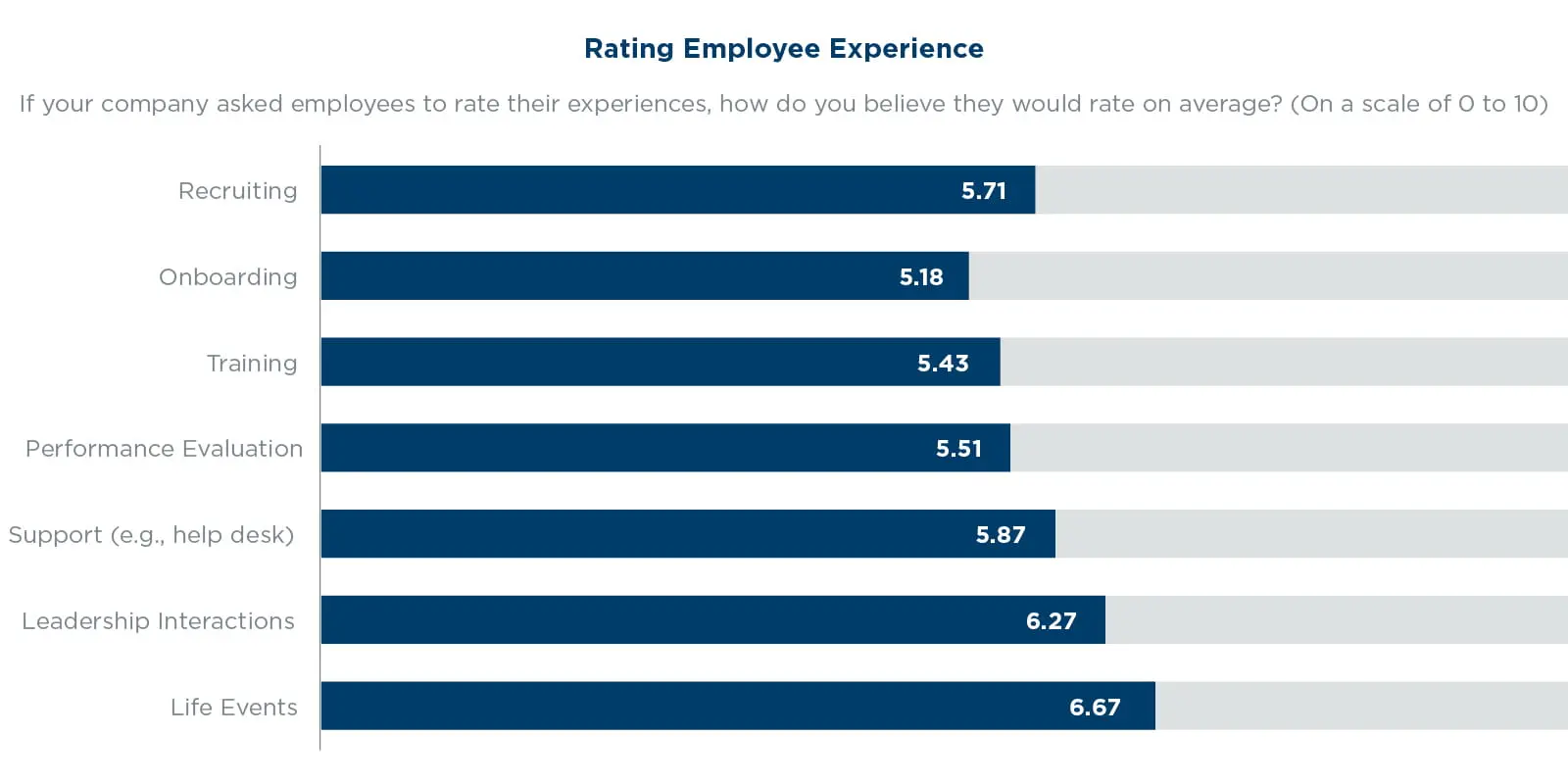
- Addressing the pain points in their employee experience and by taking a more active, empathetic role in intentionally designing how they work and interact with the company
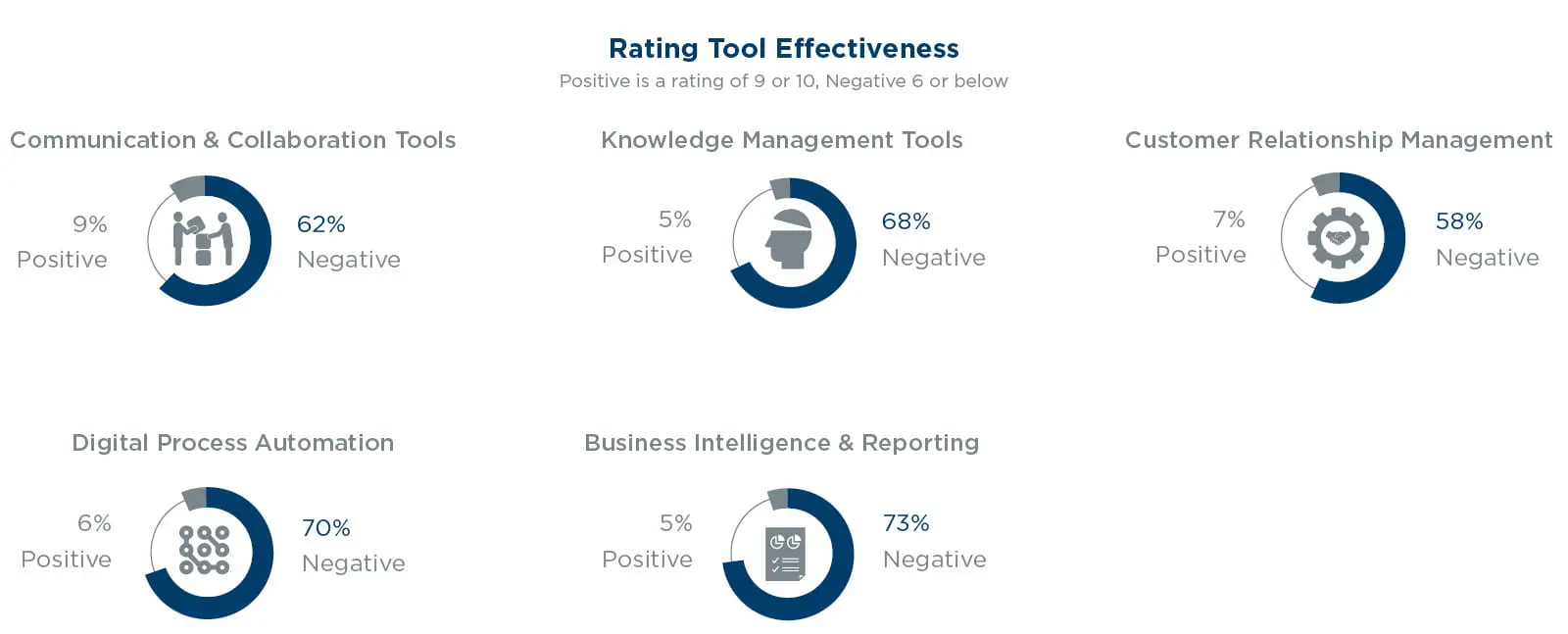
- Creating digitally enabled champions who are empowered to deliver a compelling customer experience, automating mundane tasks, equipping employees with appropriate data, and by enabling collaboration and learning
Methodology
In 2017, West Monroe surveyed members of the Customer Experience Professionals Association and the Association for Change Management Professionals about their perceptions of effort to engage and empower employees to deliver a differentiated customer experience. Approximately 110 members participated in the survey, representing a wide range of industries. Respondents represented roles from CEO to practitioner, with about half being directors or managers. More than 60% are in customer experience roles, with other concentrations in customer insights, marketing and marketing research, and operations.