


Article
10 priorities for software companies transitioning to a subscription business model
Challenges exist for high-tech & software companies looking to transform to subscription revenue models. These focus areas can help accelerate that leap
April 12, 2021

The high-tech and software sector continues to accelerate away from a license product model and toward a subscription-based or software-as-a-service (SaaS) product model. According to research firm Gartner, SaaS subscription services are expected to deliver a compound annual growth rate of 12% over the next five years.
The economics – stronger revenue growth, higher margins, a more predictable revenue stream, and higher multiples – remain attractive: On average, companies that derive majority of revenue from SaaS and subscriptions are seeing enterprise value multiples of around 10 times revenues, about double that of software license models and six times greater than hardware models. The strategic benefits are important, too—especially the increased customer engagement and access to usage data, which can be critical to remaining competitive in an evolving market.
This growth trajectory and the sticky recurring revenues built into subscription business models have proven popular with private equity investors. Attracted by the value creation potential, PE-owned software companies are moving faster to make the transition. In our signature research, High Tech M&A Defies the Odds, PE-backed companies have been more proactive in the adoption of subscription software models than non-PE-held companies: 40% of PE respondents said that between 50% and 70% of their technology portfolio now operates on a subscription basis; by contrast, 50% of corporate buyers said that less than half of their technology portfolio revenue currently comes from subscriptions.
Corporate software companies have a similar appreciation for the power of subscriptions but face different challenges than PE-owned organizations, which often have greater control and flexibility to absorb near-term revenue declines and cost increases in order to drive the change. Considering their focus on near-term financial results and meeting shareholder expectations, publicly held companies find it more difficult to navigate the shift to a completely new model with different revenue and margin profiles.
Notably, increasingly higher numbers of hardware and product companies – such as storage devices and routers – are getting into the subscription game, capitalizing on the software in the “box” rather than the box itself as a revenue stream.
Transformation to a subscription model represents an acute shift to a different way of operating and engaging with customers. From our work with PE firms and their software portfolio companies that have successfully made the transition to a SaaS model, we have identified these areas of focus that can help accelerate that shift and, thus, potential value.
1. Design your offering portfolio to balance customer value orientation with operational demands
Creating an optimal portfolio is a complex endeavor with a number of design considerations around packaging, pricing, and policies and practices. Keep in mind that you must be able to deliver and service what you sell without substantially adding to the cost structure, so keep design simple. Pricing should be understandable and correlated with both cost structure and a clear customer value proposition. Bundling of product features can help add differentiation across tiers.
Designing and maintaining a viable subscription portfolio requires enhanced intelligence activity to make sure you have continuous insight into competitive and market trends, as well as customer needs, their use of the product, and the outcomes they expect to achieve.
2. Enhance cross-functional coordination
Many software companies have traditionally tended to work in silos. This will hamper the transition to a subscription model. At least eight functional groups play key roles in designing and rolling out change to a subscription operating model:
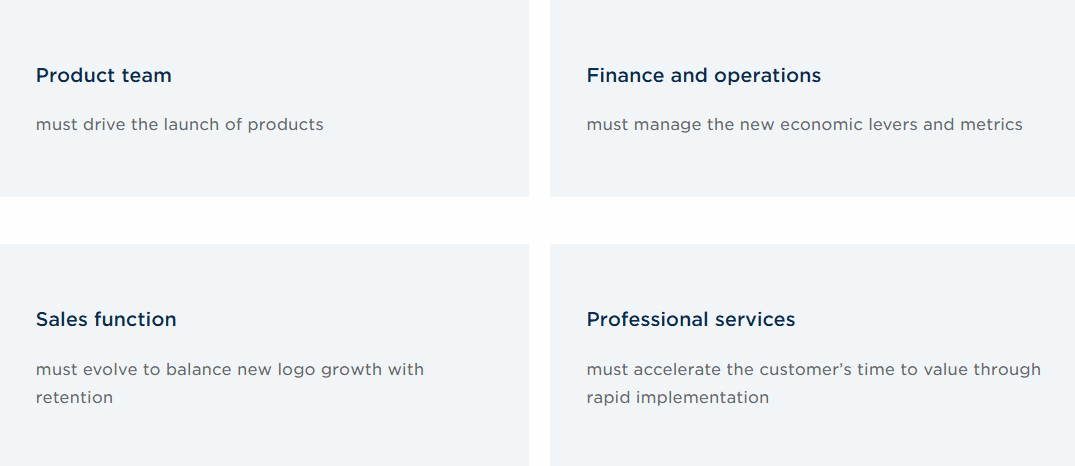
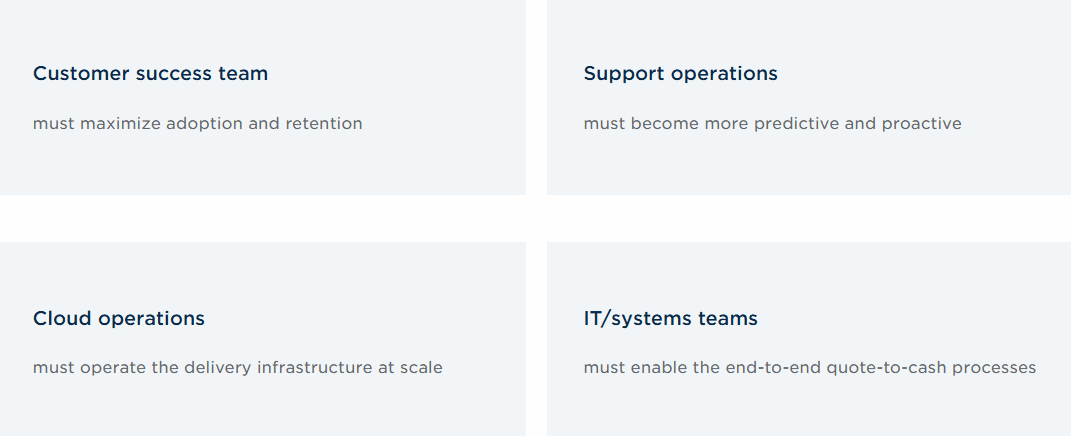
A sound data management foundation is necessary for these functions to operate in an integrated way. Further, attention to change management and culture change requirements will be essential for driving cross-functional initiatives in a programmatic way. A subscription steering committee, comprised of representatives from key functions, can be helpful for maintaining the necessary level of coordination.
3. Set realistic financial expectations
A subscription program brings new economic and financial considerations and assumptions, which requires effective communication with investors and key stakeholders.
You will need to establish a distinct P&L for the subscription revenue streams, with modeling capabilities to project revenue and margin based on portfolio evolution. It will also be necessary to develop a clear understanding of the investment required to drive customer migration – and ensure that the organization is committed to making the necessary investments throughout the transition.
Finally, establish baseline subscription metrics for reporting purposes, including a mix of financial metrics (annual recurring revenue, net retention rates, logo churn rates, etc.), customer metrics (customer lifetime value, customer health, customer satisfaction, etc.), and operational metrics (customer acquisition cost, time to go-live, community engagement, etc.).
4. Prepare for the complexity of managing a hybrid portfolio
For most established software and hardware providers, the transition to a subscription model will be gradual rather than abrupt, where the company continues to sell and deliver traditional product models while new subscription models take hold. This will require the ability to discretely but simultaneously manage the economics and operations of blended solution (on-premise, hosted, SaaS) and pricing (license and subscription) models.
5. Update your sales and go-to-market model
To support the sales process, you will need new demand generation and marketing campaign capabilities, as well as channels enabled for selling. The sales structure and process will be different, with teams adapting to a more customer value-centered approach to selling. It’s not sufficient to just sell the license and leave; it is important to ensure that customers renew.
This will require new enablement capabilities—including training, incentives, and compensation adjusted to promote success in a different operating model. Again, be prepared for the need to run old and new sales models at the same time and for the impacts that could have on sales operations. Laying the foundation for these changes early in the process will be critical to getting a new sales model off the ground successfully.
6. Become laser focused on the customer
Customer engagement is fundamental to sustaining the growth of subscription services. Whereas past efforts focused on making the sale, the emphasis now shifts to retention. This requires purposeful and proactive design of an experience that engages the customer throughout the lifecycle to drive renewal. Engagement should be focused on customer success – that is, helping the customer achieve its business goals by using the platform. The strategy should then emphasize ways to deploy the solution effectively, increase user adoption, and realize value.
7. Accelerate digital enablement to be able to provide services at scale
Moving to a model of continuous customer engagement and service will require more touchpoints. This will quickly strain resources if not planned carefully. As you plan for engaging customers across the lifecycle, consider ways to use digital automation during selling, implementation, and ongoing support and services.
Leveraging customer usage insights to tailor engagement during different points in their journey is critical to an enriched experience. Offering try-buy options, providing contextual self-help with sophisticated search, and fostering a thriving community can aid your sales, services, and operations functions, enabling them to maintain high engagement without substantial increases in resources.
8. Identify and initiate the required front- and back-office system upgrades
To produce the right data at the right time to support new processes, expect to upgrade certain back-office and functional systems. For example, quote-to-cash tools that drive configure-price-quote and billing functions must be adapted to support new product models and revenue types. ERP systems will require updates to handle new order management, billing, invoicing, and account models. CRM systems must be able to track subscription opportunities, as well as the various activities required across an expanded customer engagement model. Further, for these systems to deliver what’s required of them and operate in an integrated way, you will also need strong foundational data – particularly customer data.
9. Don’t underestimate the impact on culture and talent
Many people across the organization will have to change behaviors and adopt new expectations in order to make this model work effectively. People need to understand what is required of them and why they are being asked to change. You will need the right metrics and KPIs to provide motivation for the transition, as well as a comprehensive change management and communication plan that addresses all relevant stakeholders.
10. Consider an acquisition to grow or establish the SaaS portfolio
One practical way to accelerate the transition is to acquire an established model and capabilities that you can build upon, rather than trying to develop them from scratch.
Like many challenges, the most important factor is good preparation
This list above is certainly not exhaustive. These are some of the key factors that can accelerate—or derail—the transition. There are levels of detail below each one of them.
Expect SaaS transformation to be a three-to-five-year journey, so it’s important to have a well-conceived and comprehensive plan guided by an established framework for SaaS transformation.