


Article
Close the gap on your digital transformation goals
In our experience, leaders can drive measurable change with these 7 opportunities
September 30, 2022



Article
In our experience, leaders can drive measurable change with these 7 opportunities
September 30, 2022
Even the best of us have room to improve.
That’s one of the key takeaways from West Monroe’s 2022 Be Digital Research—which surveyed 700 C-suite executives across the financial services, healthcare, health insurance, manufacturing, retail, technology, and utility industries, as well as 5,000 of their customers.
Executives’ responses reflected a well-earned pride in the digital progress their organizations have made. And we agree: Most are on the right path (especially compared with how many organizations operated pre-pandemic).
But, in our experience, many businesses still have a long way to go—and the data backs this up, revealing some substantial deltas between organizations’ current operations and ideal-state digital agility.
However, this isn’t a bad thing. We believe a business can’t ever check off “digital” as a completed item on a to-do list—and, in fact, they shouldn’t want to. The beauty of becoming digital is that it’s iterative and ongoing, offering organizations endless paths that continuously lead to their version of “better.” It requires end-to-end organizational change, yes—but that’s the very definition of opportunity.
So what are some of the things organizations can do differently today to continue building on their digital progress? After further analyzing our survey data, we see seven opportunities across three core categories: the organizational vision, the approach to designing and building products, and team structure and development.
In West Monroe’s survey, approximately half of executives (52%) say their organization is very effective at ensuring company-wide alignment on a vision for how digital efforts can and will support near- and long-term strategic goals. Another sizable cohort (42%) see themselves as effective, while only a small percentage (6%) of organizations say they are not effective.
But the data also showed just 25% of respondents say their entire C-suite owns—and is accountable for—the organizational vision. And if so few executives can say the full C-suite is on board? Well, then alignment with—and ownership of—the vision across the full organization probably isn’t as universal as executives believe.
Why this matters: Just 16% of organizations say lack of front-line buy-in is their biggest challenge to realizing their vision. But we believe this should rank much higher in their list of priorities. Why? Because for a business to truly transform, an organization needs every employee on board with its vision. People need to understand why it matters, where they fit in, and what they can change about their day-to-day work to align with it.
For example, a health system’s C-suite might be all in on the organization’s vision and understand why it’s important and the role they play in realizing it. But this buy-in and understanding has to trickle down—not only to other back-office functions (HR, finance, etc.), but also to the boots-on-the-ground employees, such as doctors, nurses, and techs.
Think about it: These front-line employees are equal owners of the customer experience and the product. They’re the ones interacting with patients and their families every day to deliver care—which, in a health system, is the product.
If they don’t understand their role in achieving broader strategic goals—such as creating a more seamless, more personalized patient experience using digital tools and ways of working—you’re not delivering real value to your end-users. And that means, no matter how good your care model is, your organization isn’t going to successfully realize its vision.
While most (92%) of the executives we surveyed say their organization is effective at putting the customer at the center of everything, only a slight majority (56%) say customer needs are the top driver of their product and service development processes.
As for the rest? They consider compliance and regulatory demands (29%) or competitor moves (15%) to be bigger drivers. While these are both valid—and highly necessary—considerations in any design-build-iterate process, organizations should also ask themselves: Should they really be No. 1?
What’s more, the organizations who say customer needs drive their development process can further be broken into two camps. Which one sounds more digital-first to you: the 28% of companies that hold off on developing or iterating until they have established a customer need, or the 28% that do so in anticipation of customer needs?
Why this matters: If you don’t start by thinking about the customer, it makes it that much harder to capture your customers’ minds, eyeballs, and wallets later on.
If your product strategy hinges on responding first and foremost to either regulators or competitors instead of customers, you’re already way behind. (Remember the Zune? We don’t blame you if you don’t. In an attempt to compete with the iPod, Microsoft released its own portable media player—half a decade later. Apple had already captured the lion’s share of the market, and the Zune never caught up. It was discontinued five years after its launch.)
Plus, today’s customers expect something close to mind-reading from organizations. That is, by the time buyers decide they want or need a product or service, you'd better be ready to deliver—fast.
But a “wait-and-see” strategy—versus aiming to stay one step ahead of customers—leads a longer development timeline. And customers notice: While 78% of companies believe they update their products and experiences regularly, only 59% of the customers we surveyed agree.
West Monroe’s survey found nearly all organizations are investing to some extent in back-office strategies and tactics that will build digital agility, including increasing algorithmic processes and decision-making (93%) and updating to cloud-based platforms (92%).
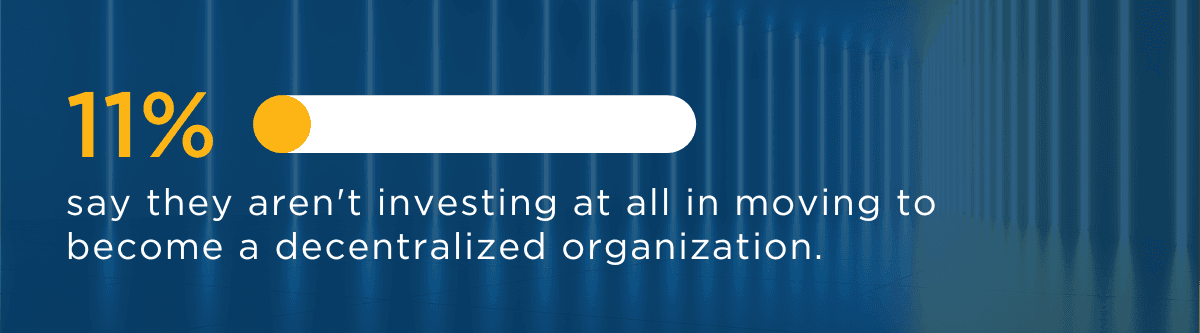
Fewer, however, said they were investing in a move to a decentralized organizational design. More than one in 10 (11%) said they weren’t investing here at all. Yet a decentralized structure is integral to creating greater digital agility.
Why this matters: In a traditional hierarchy, decisions are often made in functional silos. But working within functional siloes means decision-makers likely don’t have all the information they need to understand the potential impacts of a decision.
That not only makes for a slower, less agile decision-making process. It can also lead to leaders making the wrong decision. And the ripple effects of every decision, good or bad, trickle down and out to the end-user. One grim example of the consequences of this approach? The 2008 global financial meltdown.
The crisis didn’t occur solely—or even mainly—because of poor organizational structure, of course. But a professor of economics argues that financial firms operating with a “silo mentality” played a significant role: “Bankers and dealers sold products whose risks they either did not understand or did not care for, [and] their senior managers approved strategic plans neither understanding nor caring about the risks that were being run.”
In a decentralized, digital-first organizational structure, cross-functional workflows bring together diverse skill sets—creating agile, multidisciplinary teams oriented around a common purpose (a customer, a product, an experience, etc.) rather than a hierarchy or function. This gives teams a clear vision and roadmap, allowing them to work collaboratively and solve problems responsively.
This cross-functional collaboration and communication empowers leaders with the data and insights they need to make smarter, faster decisions centered around their most important stakeholder: the end user. And faster, better decision-making creates organizational agility—allowing teams to secure quick wins for large-scale initiatives while also making progress toward bigger milestones.
The seven ideas we present here will help you break out of some of the anachronistic ways of working that comprise a traditional operating model. But, really, they’re just the beginning. Remember, becoming digital is never-ending.
But that shouldn’t discourage you. It should invigorate you. By helping your organization become digital—one change at a time—you’ll drive incremental progress that you can build on.